Module in Art Triangular Pockets in Origami Step by Step
Surely many accept heard of this type of creativity equally modular origami. This is when origami crafts are assembled from multi-colored newspaper modules (parts). Today nosotros will begin to master the nuts of this type and larn how to make origami triangular modules.
Beginning, we need paper of the required sizes:

For the manufacture of blanks, ordinary sheets of A-iv format are suitable, which, using a ruler, must be drawn into the same xvi (4 equal parts in width and four in length) or 32 (4 equal parts in length and 8 in width) rectangles, then cut them using a newspaper knife.
As well, blanks tin exist made from stickers measuring 76x76 mm, which will demand to be cutting in half (origami masters consider this method of making blanks the most convenient).
Making a triangular origami module
The triangular module is made in vii steps:
i. Curve the rectangular bare in half lengthwise.

two.In society to outline the line of the middle, bend and unbend the folded workpiece beyond. We unfold the workpiece with an upwardly bending.

three.Fold the edges of the sheet to the middle, equally shown in the effigy.

4. Turn the resulting shape over.

5. We bend the bottom of the workpiece up.

six. Bend the corners and lift the bottom upward.

How to make a triangular module (diagram)
How to brand a paper module (video)
What tin be done from modules
Modular origami is a special manufacturing technique various volumetric figures from paper triangular modules... It was invented in People's republic of china.
To make, for example, a swan, serpent or tree using this technique, you need to melt a lot of paper triangular modules and then connect them to get the desired shape.

Origami modules are triangular in shape and they are made from rectangular pieces of paper... These rectangles tin be of different sizes, for instance 53 × 74mm or 37 × 53mm. To get the desired size, you demand an A4 sheet.
Set up A4 paper (standard sketchbook paper, or newspaper for printing or copying).

1. Fold the paper in half, then again and again - if y'all unfold the newspaper, you become 16 divisions.
* You tin fold the paper one more time, then there will be 32 divisions, and they will be less.
ii. Cut the paper into 16 or 32 rectangles.
* Y'all tin can use both pair of scissors and a stationery knife for this, the latter will be faster.
3. Fold i of the resulting rectangles in one-half in width.

four. Now fold in half lengthwise and render to original position (go back to step 3). In the middle, you at present have a line with which yous tin fold the module evenly.

5. Starting time fold one side of the rectangle towards the middle, then the other (similar to folding an airplane).

half-dozen. Now fold the edges of the segments that beetle.

7. Yous demand to curve the protruding segments upwardly.

8. Curve your construction in half (connect the 2 sides of the module).


Such modules demand to exist fabricated equally many equally necessary to assemble the desired construction.
How to make a triangular module (diagram)

How to make a paper module (video)
Modular origami. How to make a module.
The main thing to have for modular origami is paper and great patience... Due to the fact that the figures in modular origami are not quite pocket-sized, many modules need to be prepared for them, from several hundred to several thousand.
Each module has ii pockets. With their help, you can connect modules.
Commonly, no glue is used when folding the modules, since the frictional forcefulness prevents them from disintegrating. But it then happens that in some places the paper structure is non stable, then information technology is strengthened by gluing several modules PVA gum.
Can be used both pure white and colored newspaper... Office paper will work, but y'all tin can also use mag pages and even processed wrappers. Plain colored newspaper is quite thin and tears at the folds. Information technology tin be used to create pocket-size modules (if you divide A4 paper into 32 pieces).
To connect modules, simply insert them into each other. This tin can be done in several means.
For example, like this:

What can be washed from modules
And if y'all are passionate near this kind of art, then very before long you volition be able to brand, for instance, the following models:


Triangular module
This module is used in most crafts. modular origami
A4 sheet is divided into equal rectangles, and choose the size yourself. The more rectangles, the smaller the module. I brand modules based on this ratio.


1. Fire the rectangle in half lengthwise.
2. Curve across, notice the heart, and unbend. Lay by bent corner
3.Fold the edges towards the middle.
4. Plough the product over
v.Fold the protruding edges up.
6.Identify the corners behind the triangle.
vii. Unfold the lesser
8.According to the resulting lines, lay the corners and heighten
Bottom up
9.Fold the module in half
10.triangle module ready
assembly video
———————————————————————————————————————- The kickoff is the canvass fusion process

The rectangles are narrower, they fit in almost the same way, but there are slight differences in associates of the module.
———————————————————————————————————— for tangram models.
Tangram models are assembled, as a dominion, from modules folded in a triangle, the so-called bones modules. The second type of modules - additional - due to its narrow long shape, is used to create leaves, heads and necks. The basis of both types of modules is a foursquare. Folding the modules is a fairly simple process.
Origami modular associates diagram:

Basic module from the square.
We first to make origami out of newspaper -
module.
1. Commencement, place a piece of paper on the table with one corner facing you. Then bend it diagonally up to form a triangle. The long side is at the lesser.
2.In the second step, adhere the right corner to the upper, middle corner and make a fold.
iii.Now the left corner is next. It also needs to be attached to the superlative corner. Now yous have a foursquare in forepart of you.
iv. Flip the square over so that all corners remain at the top.
v. Fold the top sail of the square down and brand a fold.
vi.Then fold down the correct square.
7. Do the aforementioned with the left corner: bend information technology from top to bottom. If you did everything correct, you will become some other triangle.
viii.Finally, fold the right half of the triangle to the left.
nine.Basic module is ready for assembly modular origami from paper.
10.This is how the base unit looks from the side. Two slots for inserting other modules are clearly visible. In this perspective module stands on its long side, the double finish (head) is directed backward.
——————————————————————————————
Additional module.

- Beginning, lay the foursquare with one side facing you. Then fold information technology diagonally and open it once again. You can now see a vertical fold.
- Fold the correct side to the middle fold so that a narrow corner is at the top.
- Then fold the left side in the direction shown in the moving picture. A narrow corner is formed at the bottom.
- 5. Bend the right and left sides to the heart again to grade a diamond.
6. Fold both sides of the diamond together along the eye fold
7. Finally, fold the triangle upwardly again - and the boosted module is gear up.
This is how modules are assembled.
In that location are no related articles.
Decor, DIY
Regina Lipnyagova

Photograph © Regina Lipnyagova
Modular origami is incredibly pop today. Beautiful volumetric figures from triangular paper origami modules expect luxurious. Also, this type of needlework is called 3D origami, it is believed that this art originated in China. Its other proper noun is Chinese modular origami. You can brand almost anything from small triangular modules. Having figured out the intricacies, you can make origami vases from modules, origami swan from modules, origami Easter egg from modules, origami flowers from modules, origami peacock from modules, modular origami dragon and much more.
In this tutorial, we'll bear witness you the nuts - how to make an origami module correctly. The scheme is quite uncomplicated, the master thing is to strive to make all the pieces of paper as identical as possible.
We need:
- scissors
Materials:
- paper
Pace-past-footstep instructions on how to make an origami module:

To brand an origami module, nosotros need newspaper and scissors.

We cut the sheet into 16 identical parts. You need to attempt to exercise this equally carefully equally possible, all parts should be the same. Someone prefers to fold a canvas of paper in half and cut until a piece of paper of the required size is obtained, while someone draws a canvas with a ruler and cuts several sheets together at in one case.

Fold the paper in one-half lengthwise.

Bend in one-half across.

Having fabricated a fold, unfold the rectangle dorsum.

Bend the right side to the fold line at a right bending.

Bend the left side in the same way.

We plow the module over.

We wrap the base of operations of the triangle upwards.

We plow the workpiece over.

Cutting off the remaining ends with scissors.

We curve the workpiece in half. It turns out that making an origami module is very unproblematic. He'due south ready!

To connect the modules together, you need to put the module on the ends of two elements.
Leave your opinion well-nigh the article:
Modular origami is a very exciting activity that gives a lot of scope for creativity to everyone who has mastered the simple technique of making newspaper modules.

You can use special paper sheets designed for making origami, but their toll is normally quite high, then at least at the preparation stage it is better to utilise ordinary paper for a high density printer - from lxxx grand / one thousand 3 and above (for example, Spectra Color).
We accept an A4 sheet. Depending on the size of the modules, the paper sheet will need to exist divided into xvi or 32 pieces. If we need 16 parts, fold the sheet horizontally twice, if 32 - iii times. In the picture beneath, we folded the workpiece three times, if you demand xvi workpieces, then practice not brand the last bend.
Now nosotros unfold the sheet and fold information technology in half vertically (the fold should remain on the left side). So we bend it twice horizontally 2 times. Expand the sail. On it we volition meet the fold lines along which we have to cut the blanks for the modules.
The sheet to be divided into 16 parts looks like this.
And this is how a sheet looks like, which will be divided into 32 parts.
Cut the canvass along the fold lines. From each small rectangle, nosotros accept to make an origami module, the assembly diagram of which is presented beneath. For beginners, information technology is meliorate to showtime assembling modules from 1/sixteen of a sheet of paper. Modules from 1/32 turn out to be more miniature and svelte, but the process of assembling them requires a sure skill.

1- take a small-scale rectangle;
3- now we fold it in half vertically;
5- bend the "wings" on both sides;
7- curve the corners;
9- nosotros bend the module, it takes the shape of a triangle.
11, 12-fastening modules to each other using pockets.
Using modules every bit parts of a constructor, you can create the well-nigh bizarre volumetric shapes that your imagination can tell you from them.

Necessary materials:
Origami modules - pace by pace instructions


Putting the corners of some modules into the pockets of others, we volition exist able to create voluminous paper crafts of whatever shape and size.
If you seriously decided to study the oriental method of making all kinds of newspaper figures using a modular technique, so first of all yous need to understand how to make a module, the scheme of which is very simple.
The art of creating models from newspaper without scissors and glue came to us from Japan. Presumably, ancient China, where paper showtime appeared, became the birthplace of this type of needlework. Like everything oriental, origami carries with it the smoothness of lines and is used equally a method for relaxation.
Following the scheme, endeavour to do the piece of work very advisedly and accurately. Consider the fact that modules are like the bricks that make up a masterpiece.
How to make an origami module
So, for work we need an A4 sail.
We divide the entire sheet into equal rectangles:

Afterward cutting, take one rectangle and fold it in one-half:

We fold this half in one-half once again:

This is necessary to indicate the middle of the leaf in guild to fold the edges in the form of a triangle:

Now the edges of the workpiece must be bent to the heart outlined before to get such a triangle:

We turn the workpiece over and again bend the edges to the heart. Try to leave a minor distance between the large and two pocket-size triangles:

At present we need to fold the lesser triangles upward:

We have got an even triangle, which nosotros need to curve in half again:

Our module is ready.


The finished chemical element has 2 corners and a pocket, which are used to connect the modules to each other.
The connexion looks like this:

Too, for clarity, how to make a triangular module for origami video is simply necessary:
Mastering the "modular figurines" technique on the example of a swan
So, we take already successfully figured out the question of how to make a triangular module for origami. Now let's endeavour to brand simple figures using this technique. Our first creation will be a swan:

Information technology is very uncomplicated and on its example y'all tin understand the process of connecting elements.
The whole process of creating a swan is described in the diagram:

The first step will be nesting four white modules into each other.

Make sure the long ends are turned to the left. Then we place 1 module with its double end to the bottom and attach the remaining 4 modules. Information technology turned out the tail of the hereafter swan.
To get the wings, you need to insert the opened module on each side into the base of the figure (iv large modules).
For the neck, we need ix smaller modules. They fold upwardly similarly to the body of a swan - into each other. Note that the double end of the module must be at the lesser.

Now nosotros make a bird's beak from the ruddy module, inserting it with its double end into the end of the neck, that is, the long base should exist below. We connect the neck and trunk. And our swan is prepare. This was the easiest style to create modular origami.
If you have hands coped with this task, so you are ready to move on to more complex modular origami models. Y'all can make a cat, a vase, and even a whole fruit handbasket.


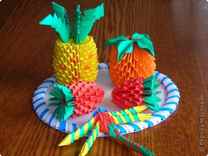
The process of creating a modular origami is a very exciting process that quickly becomes addictive. Simply it requires the utmost concentration and attention, which is typical of oriental fine art. So accept your time and exist patient in the process of creating your adjacent masterpiece.
How to make an origami module: video tutorial
The fine art of origami is mayhap the most amazing of those arts that originate in Japan. Modular origami is especially popular. Volumetric figures fascinate with their advent lonely. At beginning glance, it seems that making them is very hard. Only in reality, it is plenty to primary only a few simple techniques.

How are modular origami assembly schemes different from ordinary ones? In gild to make a figurine on them, y'all need to assemble several paper modules in advance. Sometimes information technology is 20 modules or more.

The module is a small paper triangle. To make information technology, y'all demand a sheet of newspaper and ordinary scissors.
The algorithm of actions looks like this:
- Fold a sheet of A4 paper until it has 32 or 16 squares.
- Cut the sheet along the fold lines.
- The side by side stage is the assembly of the module itself. According to the instructions, the piece of newspaper must be folded in half in width.
- Fold in half again. Expand back. It turns out a blank, as in the photo.
- Adhere two sides of the rectangle to the conventional line in the center, while carefully bending the edges.
- At present the figure that has turned out needs to be bent again. How exactly is shown in the photo.
- The last footstep is to fold the finished module in one-half.

With the help of the resulting figures, a modular origami paper for beginners is being assembled.
Where to begin
Novice masters first of all need to learn how to read modular origami paper diagrams.
Most often they use two designations:
- The module looks upwards. If the instructions include such an icon, the elements should be folded so that the short side looks out. Near frequently, the bases of the figures are indicated in this way.
- If the module looks downward in the instructions, the parts are installed outward with the long side. Thanks to this, you can create rounded shapes, such as an egg, ball or drupe.

It is too worth paying attention to the main types of lines, folds and folds. Several of them tin be distinguished:
- Mountain line. The newspaper is folded so that the fold is facing outward.
- "Valley". Hither the fold looks in.
- "Invisible line". This is a line that can be guided by in the process of work.
- Wrapping "mountain" and "valley". They are double fold inwards or outward.

Among other things, in the process of assembling modular origami, novice craftsmen will have to deal with the following elements:
- turning over modules;
- rotation in the same plane;
- alternation;
- pocket design;
- inflation;
- connectedness of several points.
Knowledge of all the elements will allow you to collect low-cal figures from 20 modules or more than.
Illustrative examples: "Herringbone"
The instruction for modular origami "Herringbone" shows by case how and in what gild to get together the figures.
Fifty-fifty beginners and inexperienced craftsmen can handle this scheme:
- Offset you need to make modules from white and green paper.
- You will need 16 green modules. They will be used to create i and 2 levels of the tree.
- Connect 8 light-green triangles and a ring. This is the first tier.
- For the second tier, you need to take the aforementioned number of modules. Only now they will alternating with white ones.
- The next step requires xxx green parts. Of these, 3 circles should be formed, 10 modules in each. Insert 5 white parts hither.
- For the quaternary tier, y'all need to repeat the previous paragraph. This tier will consist of fifteen greenish modules. They should be located according to a sure pattern. Elements of this tier are put on the corners of the modules of the previous i, and and so on in a circumvolve.
- 5th tier - 4 white modules, which are installed on the inner corners of the greenish ones.
- To create the adjacent tier, you lot need to make a ring of 48 modules (four rows of 12 pieces).
- In the process of creating a Christmas tree, you lot volition need and so-called legs. They are crafted from 4 dark-green parts and ane white part. Kickoff, the green ones are connected: insert the correct corner into the right pocket. Practise the same with the left corner and the pocket. Connect the resulting two parts with a white module.
- For level six, yous demand to collect a circle of 56 modules (4 rows). On the fifth row, insert vii more parts, connecting them with the modules from the previous row.
- To create the superlative, yous volition need 4 external and internal modules, which will be continued to each other in a ring.

To gather a modular origami figure, y'all demand a stick made of wood. Prepare tiers are put on it one by one (from 6 to 1). At the terminate, the crown is fixed.

Beginner fans of modular origami can get the job done with a tutorial video.
Figure "Swan"
You tin brand a beautiful swan figurine from triangular modules. It does not vest to the easy ones, but if yous strictly follow the scheme, then fifty-fifty novice craftsmen can handle it.

To work, you need to make 458 modules of white newspaper and ane of red (as an option - yellowish or orange). The colour module will be the swan'due south neb.

The workflow looks something like this:
- Lay out iii parts according to the diagram, 2 at the top and 1 at the bottom between them. Insert the upper corners into the lower pocket.
- Install three rows in the same mode. At the end, you should cease up with a ring of xxx elements.
- Echo the same steps for iv-five rows.
- "Unscrew" the resulting structure (press on the center with your fingers) to become a semblance of a crown.
- Brand 6 row.
- At the seventh phase, wings are added.
- Starting from row viii, one module must be removed in each fly. At the end there volition exist only one left.
- Make the tail in the same way.
- To create the cervix and head, you need to have 19 white parts and one colour.
- The concluding phase is the connection of the neck and torso.
These are just the primary steps in the workflow for creating a swan. Features and nuances of the process are described in the photo and video. Novice craftsmen can easily make this figurine.
Modular origami for beginners is a good fashion to practice creating real masterpieces. It is enough just to learn the process of creating the bones parts and the rules for their connection.
Materials and tools
What paper is best for making crafts? How to craft many modules faster? What is the best module size? This department will reveal the secrets modular origami and will help yous take your first creative steps.
Paper selection
♦ Office paper... This is the most suitable paper for modular origami: information technology is quite dense and not too polish, then the modules practise non slip when connected and agree well. Colored office paper is colored on both sides and does not fade on the folds.
♦ Blocks for notes (stickers)... Square stickers are suitable for the Superball Kusudama module and the Trefoil module. Triangular modules are usually made up of rectangular pieces of paper. The approximate aspect ratio of such a leaf is 2: iii (for example, 14x6 cm). However, y'all can use square stickers cut in half. The aspect ratio in this case volition be 2: 1. The module will be thicker. For some crafts, this is even C proficient. There are also rectangular stickers that exercise non need to be cut.
Communication. When using writing blocks with an adhesive border, fold the module with the viscid side inwards.
♦ Origami newspaper... Special paper for origami also called kami (Japanese for paper). It is already cutting into sheets of a sure shape, ordinarily foursquare. The value may vary. Commonly one side of such a canvass is white, and the other is colored, at that place are several unlike colors in the set. There are colored newspaper on both sides and paper with an ornament.
♦ Colored paper for children's inventiveness... Some types of such newspaper tin can be used, simply you lot need to check to come across if it tears at the folds. For modular origami, as a rule, you need a lot of paper of the same color, and in kits for children's inventiveness there are just a few single-color sheets. However, for example, black or brownish paper is difficult to find, and it is necessary to accept it from such sets.
♦ Magazine paper... Newspaper from mod glossy magazines (with both pictures and text) works well for modular origami... Choose newspaper that is not also thin. If yous sort the modules by color, you can get very interesting painterly effects in the assembled production. Several of these items are featured in this book.
Moodle paper size
The size of the pieces of paper for folding the modules can be different - big or small-scale. The size of the future crafts depends on this. For triangular modules, information technology is convenient to use sheets of 1/sixteen or 1/32 of a standard A4 sheet.
♦ If you carve up the long and short sides of an A4 sail into 4 equal parts and cut the sheet along the marked lines, yous will become rectangles approximately 53 ten 74 mm in size.
♦ If you separate the long side of an A4 sail into 8 equal parts, and the short side into 4 and cut the canvass along the outlined lines, you get rectangles almost 37 x 53 mm in size.
You tin as well choose some other size. For example, almost all of the crafts in this book are made of modules with the original paper size 38x60 mm (or 4X6 cm). In some cases, 76 x 76 mm bisected stickers were used. But whatever size of the module y'all cull, it is most user-friendly to dwell on it when making all the crafts. So they volition be compatible with each other and the Christmas tree folded for the New Twelvemonth can plow into a palm tree, and then into a peacock or something else.
Tools and additional materials
♦ Stationery pocketknife and ruler... Before you start folding the modules, you need to cut the paper into rectangles or squares if you are non using stickers of a suitable shape. It is user-friendly to cut several layers of paper at once. It is very difficult to practice this with scissors. Information technology is improve to cutting the paper with a practiced jotter knife using a ruler. The ruler should exist firm, preferably with a recess or handle for holding. Identify a difficult board under the paper. If possible, purchase a dedicated paper cutter.
♦ Glue... Most of the triangular modules presented in this volume have been done without the use of glue. Information technology is very comfortable. Any arts and crafts can exist disassembled and created something new. The glue is used just for attaching modest parts - peephole, jewelry, etc. If desired, information technology can be replaced with an adhesive mass. Notwithstanding, if yous plan to utilize the arts and crafts as a children's toy, as a gift or as an exhibition copy, so it makes sense to accept care of its immovability. You can employ thick PVA gum or glue stick when assembling. And when working with the Trefoil module, glue is required. With the assistance of glue, flower petals are connected; it is also needed in the manufacture of stems and fastening the leaves.
♦ Adhesive mass... A very handy invention! Reminds me of a cross betwixt double-sided tape and white plasticine. You tin tear off a piece, curlicue it into a ball and attach any
particular outside or inside the craft. The part tin exist removed when necessary. This mass leaves no traces.
♦ Paints... The entire craft can be made from white office newspaper, and and so covered with paint from a spray can with a spray bottle - aureate, argent, or any color.
♦ Sewing thread with a needle... Kusudama "Superball" modules are interconnected with a needle and thread.
♦ Boosted details... When making crafts, you will need ready-fabricated eyes for toys. They come in a diverseness of sizes and shapes. You lot tin can depict the optics yourself on thick paper or print set up-made images of the peephole of the desired size and type on a printer, which tin can be establish, for instance, on the "Country of Masters" website. Ribbons, beads, sequins, beads, etc. are suitable for decorating crafts.
Origami modules
At that place are many varieties origami modules: flat - for mosaics, volumetric - for kusudam and various figures. The mosaic modules are just glued to the base close to each other. Volumetric modules can be glued to each other, stitched together or continued in a constructive way (protruding parts of one module are inserted into the pockets of another). Consider how 3 types of volumetric modules are performed, from which all the products presented in the volume will be assembled.
Triangular module

The triangular module is the basis of the crafts presented in the book. As mentioned higher up, you will demand a rectangular piece of newspaper to complete this module.
1. Fold a rectangular slice of newspaper in one-half lengthwise.
2. Fold beyond to mark the midpoint and unfold. Lay the corner upward.
3. Fold the edges towards the heart.
4. Turn over.
5. Fold the bottom up.
6. Fold the corners over the large triangle.
vii. Unfold the corners and bottom.
8. Fold the corners again along the marked lines and lift the lower function upwards.
9. Fold in half. The resulting module has ii lower corners and two pockets. Such modules can exist inserted into each other in various ways and obtain iii-dimensional figures. The figurine folded from modules can exist easily disassembled. One of the possible connection methods is shown in the photo.
Attention! The side lying in the triangular module opposite the right angle volition hereinafter exist called long. The side opposite the 60-caste angle is short.
Kusudami "Superball" module
One of the objects modular origami is kusudama - a spherical figure assembled from modules of various shapes. The classic kusudama "Superball" consists of 40 modules in the grade of flowers, also called floral.
These modules can serve every bit a basis for creating various crafts, such as dolls. In add-on, they can be used to brand blossom cores or flowers themselves. The kusudama module "Superball" is fabricated of a foursquare piece of paper. For kusudama, it is better to utilize double-sided colored paper, for other crafts, depending on the intention.


ane. Place a square piece of paper with the back side upward. Mark the lines of the diagonals by bending and unbending information technology. Plough over.
ii. Mark the vertical and horizontal centre lines by folding and unfolding the piece of paper. Turn over.
3. Fold over all marked lines at the same fourth dimension. The basic shape is a double foursquare.
four. Identify the shape "entrance" downwards and fold the edges towards the centre in the front and back.
5. When folding the edges, in that location are four pockets. Open ane of the pockets and flatten it out.
6. "Flip" the left side of the workpiece to the correct.
vii. Perform the same performance with the paired "pocket", equally well every bit the two remaining ones.
viii. Open the workpiece on the not-pocket side. Fold the edges towards the middle.
9. Fold the corner.
10. Perform steps viii and 9 three more times, "turning over" the workpiece.
11. Fully unfold the received workpiece.
12. Press in the middle of the folded sheet of paper so that it becomes concave. Now build the final module. Start at the top left corner. Grasp the edges of the paper with your hands where the dotted lines are in the photo.
13. Bring the pleats back around the corner of the square. The dotted folds should run into at the back.
14. Fold the edges of the resulting "petal" to the middle along the previously marked folds.
15. Fold the corner inwards.
16. "Swipe" the right side of the resulting figure to the left. Perform the side by side petal in the same way.
17. Fold the edges of the petal and the corner once again.
eighteen. Perform steps sixteen and 17 twice more.
Shamrock module
From such modules, you lot can brand various mosaics, applications and volumetric products. Yous will need a square piece of newspaper to fold the module.

1. Identify a square piece of paper with the back side upwardly. Bend diagonally and straighten.
two. Fold the edges towards the centre.
3. Fold the corner up and tuck in.
4. Fold the side corners towards the heart.
5. Now the corners need to be tucked into the workpiece. Unfold the left corner, then unfold the unabridged left side of the workpiece.
half-dozen. Constrict the corner inward, fold the left side.
7. Practice the same on the right side.
viii. Rotate the workpiece 180 ° and fold the edges downward.
nine. Flip over to the other side.
10. Fold the edges towards the middle, with the back paper coming out.

Post a Comment for "Module in Art Triangular Pockets in Origami Step by Step"