The First Evidence of Art Was Discovered Years Ago
Confirmed: The Oldest Known Fine art in the World Is Spray-Painted Graffiti
The outset paintings always made by human hands, new research suggests, were outlines of man hands. And they were created not in Spain or France, simply in Indonesia.
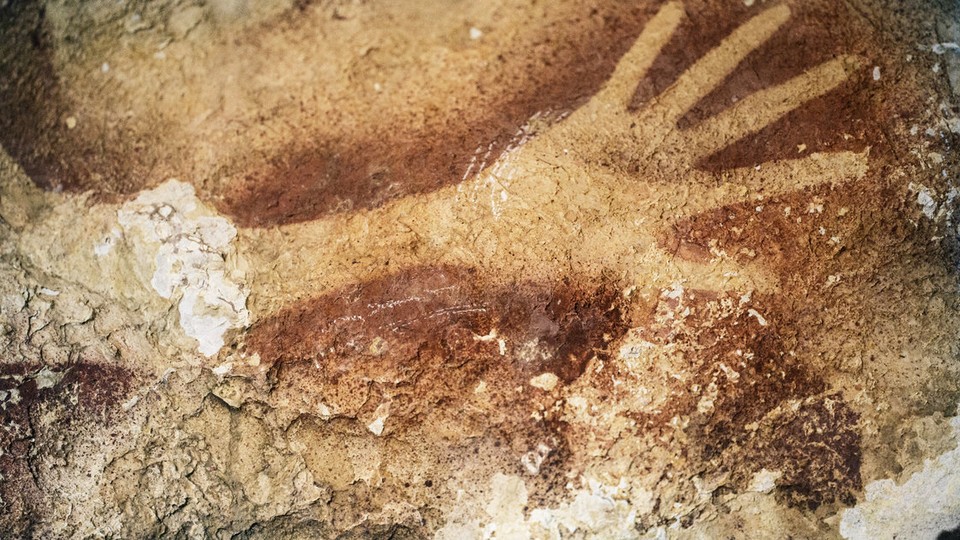
Sixty years ago, on the Indonesian island of Sulawesi, a group of archaeologists discovered a series of paintings spread beyond 100 limestone caves. The images—rendered, by the time of their discovery, in sepias of varying saturations—featured stencil-like outlines of human hands and stick-legged animals in motion; they were in advent, at to the lowest degree, quite similar to the cave paintings that had already been discovered, and made famous, in Spain and France.
The paintings were proto-graffiti. They were early versions of that car window in Titanic. They were humans, making their mark.
They were likewise, plain, old. But they were not, it was thought, oooooold-old. They couldn't have been created, their finders figured, much more than than 10,000 years ago. Had they been whatsoever older, everyone causeless, they would have faded away in the humid tropical air.
But you know what they say about assumptions. Co-ordinate to a paper published today in the journal Nature, those paintings, etched into those caves, are much older than those first scientists had thought. Tens of thousands of years older, in fact. Then old that they are now thought to exist the oldest known specimens of fine art in the world. If art is ane of the things that brand us human … and so it seems we've been human for even longer than nosotros've realized.
That information technology took u.s.a. and so long to brand that realization, though, is a reminder of some other things that brand the states human: technological limitation, resource limitation, cultural myopia. It's long been assumed that the oldest human paintings were created in Europe, in the caves of France and Spain. That'southward an supposition that has political implications besides equally scientific ones. "The truth of information technology was, no ane had really tried to date information technology," the Smithsonian's Matt Tocheri told NPR of the Sulawesi detect.
That wasn't because we lacked the tools to exercise the dating. While the Sulawesi paint itself can't be accurately dated, what nosotros've long been able to exercise is to judge the age of the rocky bumps—calcium carbonate, more ordinarily and more delightfully known as "cave popcorn"—that now encompass it. Uranium-thorium dating takes advantage of the decay rate of uranium as it turns into thorium to gauge, to a loftier degree of accuracy, the historic period of the rock in question. Information technology allows scientists to make up one's mind an age—a minimum age—for the paintings that comprehend the cavern walls.
Using that method, the Griffith Academy professor Maxime Aubert and his squad were able to make up one's mind that the Sulawesi paintings are, at minimum, 39,900 years old. Which makes their minimum age at least 2,000 years older than the minimum age of the oldest European cave art. (While the paintings are strikingly similar in content—human hands, animals teetering on stick-like appendages—they are besides strikingly different in manner. The Indonesian images "look 'line-y,' about similar brush strokes," Alistair Pike, the archaeologist who identified what was preciously considered the world's oldest cave art, in Europe, told Nature. Early European images, on the other hand, "look dabbed, almost like finger paint.")
All of which make the Sulawesi dating not just a scientific discovery, and not just a cultural revelation, just also something of a political point. "It allows us to move away from the view that Europe was special," Aubert told Nature. "There was some idea that early Europeans were more aware of themselves and their surroundings." The discovery of proto-art in Indonesia—the flecked and frozen outlines of the easily of unknown humans—negates that idea, scientifically. "Now," Aubert says, "we can say that's not true."
Source: https://www.theatlantic.com/entertainment/archive/2014/10/humanitys-earliest-art-was-spray-painted-graffiti/381259/

Post a Comment for "The First Evidence of Art Was Discovered Years Ago"